Why Your Body Adapts — And Why Balance Matters More Than Perfection
May 21, 2026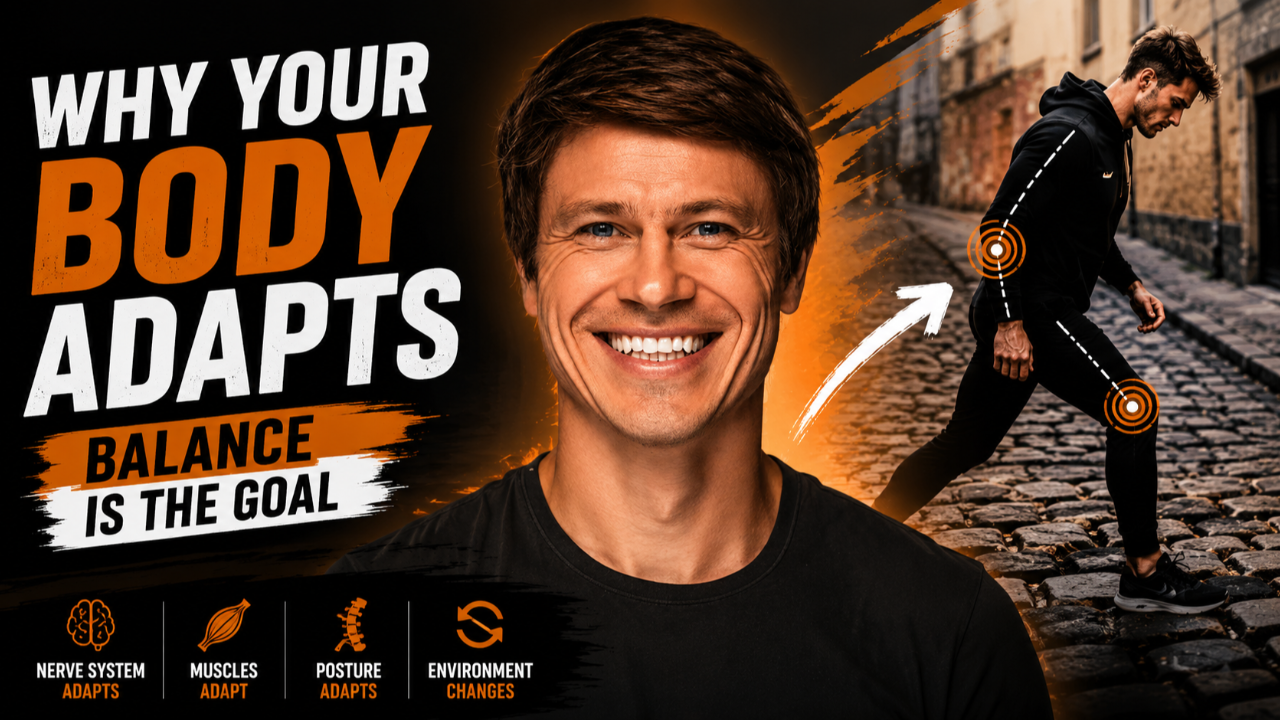
For many years, I thought the stronger and harder you train, the better your body will become.
Gymnastics taught me discipline. It taught me how to control my body. It gave me opportunities to travel the world, perform more than 2,000 shows with Cirque du Soleil, and help thousands of people through training.
But later, I understood something important: your body always adapts to what you repeat most. And adaptation is not always healthy.
Sometimes your body becomes effective for one task — while slowly losing balance in another area. That is the real price of specialization.
The Body Always Chooses Efficiency
When people watch high-level athletes, they usually see only the final result — the medal, the strength, the flexibility, the performance. But behind every result, the body creates compensations.
If you repeat the same movement for years, your nervous system, muscles, fascia, joints, and even bones start adapting specifically for that task. This is why professional tennis players often develop one side of the body more than the other. Why pole vaulters jump from one side only. And why most gymnasts kick up to handstand with the same leg for years.
Your body becomes extremely effective for one movement pattern. But effectiveness and balance are not always the same thing.
Why I Still Feel One Side More Tight
I started gymnastics at 4 years old. From age 4 to 20, I trained around 4–6 hours per day, 6 days per week. For years, I twisted in one direction. Kicked up to handstand with one dominant leg. Landed. Rotated. Repeated.
Now, many years later, I still feel one side of my body tighter during my morning mobility routine. Not weaker. Tighter. Like the body still remembers the pattern. Your body remembers what you practice.
The Flat Back Story
In gymnastics, especially if you are tall with long legs like me, you constantly squeeze the glutes and engage the core to create a stronger line for skills. For years, I practiced removing the arch from my lower back. Every day. For hours. Eventually, my body adapted.
Now I naturally have a much flatter lower back than most people. When I later experienced back pain, one question appeared: "Should I try to recreate a normal lordosis?"
We came to an interesting conclusion: maybe the goal is not to completely rebuild somebody else's posture. Maybe the smarter goal is to stop making the imbalance worse. This idea changed how I look at fitness forever.
Fitness and Professional Sport Are Not the Same Goal
Professional sport is about performance. Fitness is about health. These are not always the same thing.
Professional athletes often sacrifice balance for performance. The body becomes optimized for one thing. And sometimes that creates pain later.
Today, I believe recovery is the invisible side of results. Massage, sleep, recovery sessions, mobility work, breathing, hydration, nervous system recovery — this is also training. Invisible training.
The Ground You Walk On Changes Your Body
One of the strongest lessons came during my period of serious back pain. I lived in Lviv, where many streets in the old city are made from uneven stone roads.
On flat ground, I could walk maybe 20 minutes without pain. But on uneven stone streets, pain appeared after only 5–10 minutes. Because uneven surfaces demand much more from the body — more stabilizers, more coordination, more nervous system activity, more muscle engagement.
Why Unstable Training Can Improve Real Life Movement
Real life is unstable. You slip. You lose balance. You react. You step on uneven ground. You carry bags while turning. You move while distracted.
Your body needs adaptability, not only strength. This is why exercises on unstable surfaces, single-leg exercises, gymnastics balance work, barefoot training, and coordination drills are so valuable. Not because they look fancy — because they train your nervous system to solve movement problems.
You Do Not Need Perfect Symmetry
The goal is awareness — understanding your patterns and what your sport, work, posture, and habits are doing to your body. And then intelligently balancing those patterns.
If you sit a lot → move more. If you train one side → restore the other side too. If your life is very vertical and compressed → maybe your body needs hanging, crawling, swimming, mobility, or floor work.
For most desk workers, the biggest single imbalance is hip restriction from prolonged sitting. The Hip Mobility Challenge is built around this — restoring hip range in all directions to counterbalance what your lifestyle takes away every day.
Work With the Resources You Have
Work with the resources you have today. Improve step by step. Do what you can now: even 10 minutes of mobility, even walking, even breathing work, even stretching between computer sessions.
Small consistent actions change the body. Your body is adapting every day anyway. The question is: what are you teaching it to adapt to?
FAQ
Why does the body develop asymmetry from sports training?
Because sports and skills require repeated dominant-side patterns. Over years of practice, the nervous system, muscles, and even bone density adapt specifically for those repeated movements. The body optimizes for performance, not symmetry.
Is recovery really part of training, or just rest?
Recovery is active training for the adaptation systems. Sleep, massage, mobility work, hydration, and nervous system recovery all directly affect how well the body absorbs training stimulus and rebuilds. Without recovery, the training stimulus creates breakdown without the subsequent rebuilding.
Why do unstable surfaces improve real-world movement?
Because real life is unpredictable. Unstable surfaces teach the nervous system to react, stabilize, and make split-second adjustments — the same skills needed to avoid injury when you slip, step on uneven ground, or carry an unexpected load.
What does "stop making the imbalance worse" mean in practice?
It means identifying the dominant movement patterns your lifestyle or training creates — and deliberately adding movements in the opposite direction. If you sit all day with your spine flexed forward, spend time daily in extension. If you always train one side, consciously add work on the other.
Keep Reading
- The Real Meaning of Health: Your Ability to Adapt — what adaptability is and how to build it
- Why Your Heart Adapts to Your Lifestyle — the same adaptation principle applied to cardiovascular health
- Your Environment Shapes Your Body — how daily context drives physical adaptation
- The Real Training You Ignore Every Day — passive practice and why lifestyle beats workouts
- 15-Min Legs Workout: Hip Recovery Routine — a practical workout to start restoring hip mobility