The Real Training You Ignore Every Day
Mar 19, 2026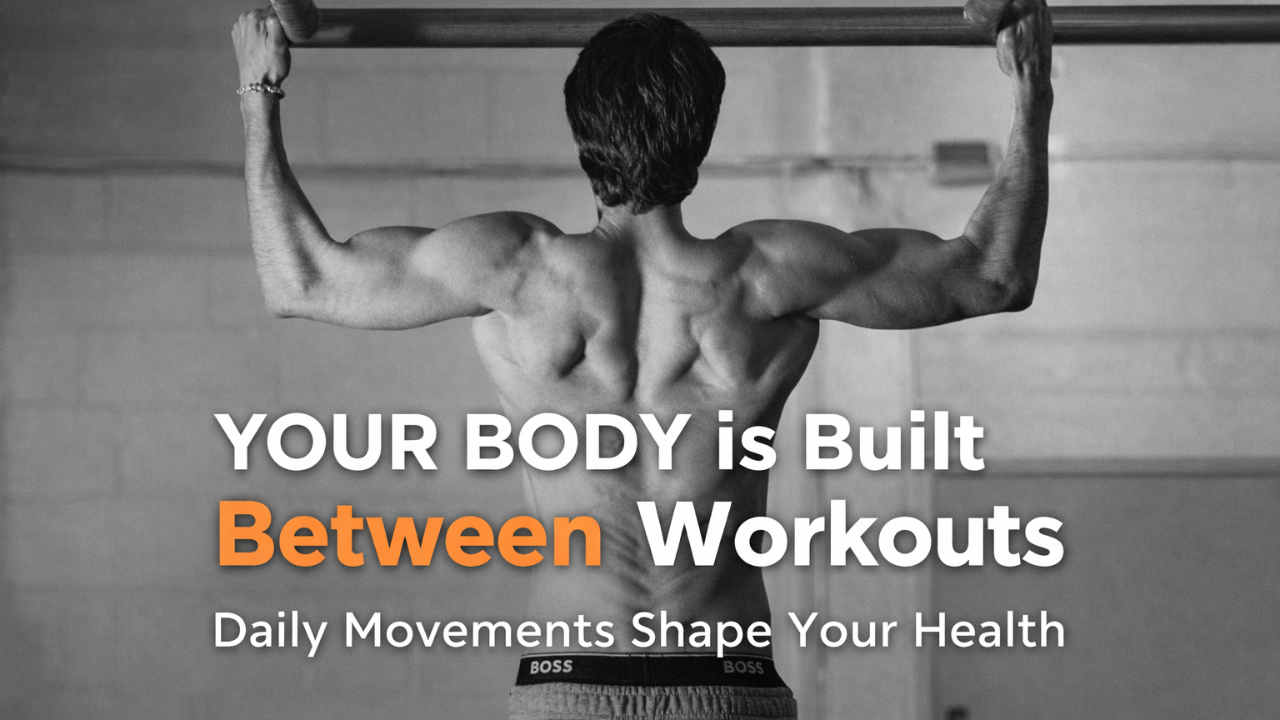
Why Your Lifestyle Is Stronger Than Your Workout
You train one hour. Then you destroy everything in the next four.
This is the uncomfortable truth most people do not want to hear.
You Train... But You Also Practice Being Broken
You decide to fix your posture. You're motivated. You train. You do your 30–60 minute session. You follow the program. You feel good.
Then you sit. Laptop. Phone. Couch. Back rounded. Head forward. Shoulders collapsed. Not for 10 minutes. For 4–8 hours.
And here is the key idea: this is also training. Your body does not understand "this is exercise and this is not exercise." Your body only understands repetition.
So what wins — 1 hour of good movement, or 6 hours of bad movement? The answer is obvious. Your lifestyle will always beat your workout.
Passive Practice Is Stronger Than Active Training
You have two types of practice. Active practice — your workout. Passive practice — your daily positions.
Most people focus only on active practice. Big mistake. Because passive practice happens all day long. And it is not neutral — it is shaping your body every second.
This is why people tell me: "I train, but nothing changes." No — something changes. You just don't see it because your lifestyle cancels your progress.
A Simple Fix That Works Immediately
When you scroll your phone or work on your laptop — lie on your stomach. Put your elbows under your shoulders. Open your chest. Let your lower back extend a little.
What happens? You open your chest. You activate your back muscles. You stretch your hip flexors. You reduce the time your body stays in a flexed position.
Now imagine: 1 hour in rounded posture, 1 hour in extension posture. Already better.
I Don't Believe in Awareness. I Believe in Systems.
People love to say: "Be more aware." Sounds good. Usually doesn't work for long.
You will not stay aware for 10 hours a day. Your brain is busy. Your life is full.
I believe more in habits. Habits are stronger than motivation. Habits are stronger than willpower.
You already drink coffee every day. That habit exists. So do this: stand up to make coffee. Do one or two exercises before it. Then drink coffee. Now coffee becomes the reward.
That is how habits are built. You don't need a big life reset. You need small things that are easy to repeat.
Real-Life Movement Matters More Than Gym Technique
I lift my kid every day. I can lift with a straight back — safer and more effective. Or I can lift with a rounded back — less safe and less effective. This matters because I do it again and again.
The movements you repeat every day shape your body more than the exercises you do once in a while.
Stop Trying to Fix Technique. Fix Your Body.
If you are already 30 or 40 years old, your walking pattern is deeply built into your system. The bigger win is somewhere else: improve mobility. Fix muscle imbalance. Build strength endurance. Improve coordination.
Tight hamstrings affect your walking pattern. Weak glutes put extra load on your knees on stairs. Tight inner thighs limit control. Fix the body — the movement often gets better by itself.
The single most impactful place to start for most desk workers is hip mobility. Tight hips from sitting affect posture, walking, back health, and knee load simultaneously. The Hip Mobility Challenge is built for exactly this — restoring hip range of motion with a short daily habit that compounds over time.
Why Most Training Programs Don't Transfer to Real Life
Many programs are disconnected from real life. Machines. Isolated positions. Artificial patterns. Then the person goes home and still moves badly in daily life.
Training should be closer to real movement: bodyweight exercises, control, balance, strength in positions that actually happen in life.
Because you don't live on a machine.
Daily Life Is the Main Program
Your program starts when you wake up. How you sit. How you stand. How you scroll your phone. How you work at the computer. How you carry your kid. How you go upstairs.
Daily movement is your lifestyle. And lifestyle affects your body — your posture, your health, your pain, your energy. Training matters. But lifestyle matters more.
Final Thought
If you want to change your body, stop thinking only about training. Start looking at your day.
Because your body is not built in the gym. It is built in everything you do between workouts.
I believe in you. Let's do it 💪
FAQ
Why does lifestyle have more impact than workouts?
Because of volume. A 1-hour workout is outnumbered by 15+ hours of everything else you do in a day. The body responds to cumulative load — and if 6 of those hours involve rounded shoulders, compressed hip flexors, and a forward head position, that pattern becomes what the body adapts to.
What is "passive practice" and why does it matter?
Passive practice is every position and movement pattern your body experiences outside of intentional training — how you sit, stand, scroll, sleep, and carry yourself. The body doesn't distinguish between "exercise" and "everything else." It simply responds to what is repeated most often.
Why are habits more reliable than awareness?
Because awareness is a limited resource that depletes throughout the day. You cannot consciously monitor your posture for 10 hours. Habits, once formed, run on autopilot — they don't require mental energy to execute.
What's the most effective single lifestyle change for someone with back pain?
Reducing the time spent in sustained forward flexion — specifically, breaking up sitting with brief periods in extension. Even 10 minutes lying on your stomach in the evening, opening the chest and stretching the hip flexors, can significantly counteract the postural load accumulated during a typical desk workday.
Keep Reading
- Your Environment Shapes Your Body — how your chair, city, and daily tools train you without you noticing
- Why Your Body Hurts — And How to Fix It With Movement — the posture and imbalance connection to chronic pain
- 10-Minute Full Body Mobility Routine — the daily movement practice that offsets a desk lifestyle
- Why People Get Injured (And How to Prevent It) — how daily movement patterns create or prevent injuries
- 30 Minutes a Day Can Save Your Health — the minimum effective dose of daily activity