The Real Meaning of Health: Your Ability to Adapt
May 26, 2026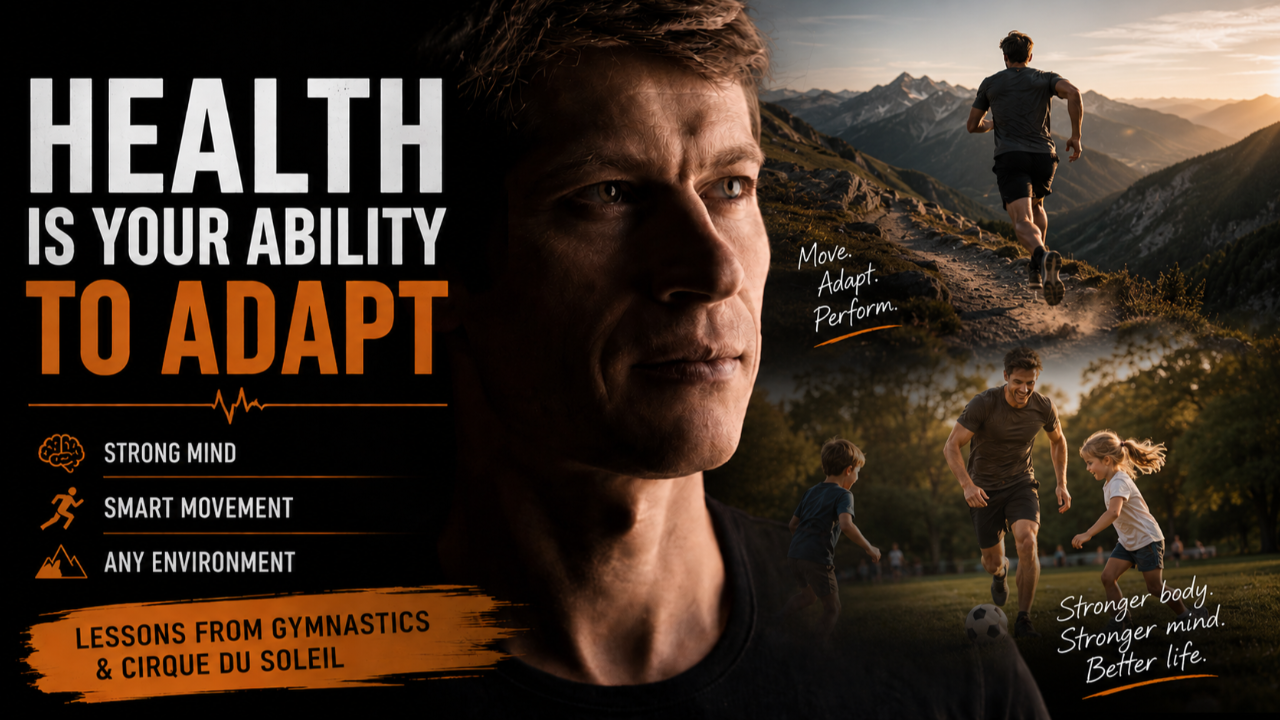
For most of my life, I believed health was not just about muscles, low body fat, flexibility, or how good you look in the mirror.
For me, health is something much deeper.
Health is your ability to adapt.
Adapt to stress. Adapt to movement. Adapt to a new environment. Adapt to pressure. Adapt to life.
The faster your body and mind can adapt to new challenges — the healthier you are.
This idea stayed with me from my university days, but I truly started understanding it during my life in professional gymnastics and later inside Cirque du Soleil.
Because performing on stage teaches you very quickly: your body either adapts — or breaks.
Why Some People Struggle More Than Others
A few days ago, I had a conversation about movement adaptation and reaction time.
And I realized something important: most people think movement is just muscles.
But movement is actually communication — between your brain, nervous system, reflexes, joints, breathing, emotions, and environment.
The body is constantly solving problems.
Hot weather. Cold weather. Slippery roads. Stress. Lack of sleep. New sports. New movement patterns. Travel. Altitude. Fear.
Your body is always adapting. Or failing to adapt.
That is why two people can enter the same situation — and one person handles it easily while the other completely falls apart.
My Bicycle Trip Reminded Me of This
Last weekend, I went on a bicycle trip with my friend.
We are beginners.
At some point, Google Maps sent us into some strange mountain route. The incline became so steep that we had to carry the bicycles in our hands while climbing uphill.
Honestly, it was hard.
But experiences like this remind me why I love movement.
Because movement exposes reality.
You immediately see your endurance, coordination, recovery, mental resilience, breathing efficiency, and stress tolerance.
When life becomes uncomfortable, your body tells the truth.
Health Is Adaptation Speed
One of the most important ideas I teach inside KONONOV Club is this: healthy people adapt faster.
You change time zones? Your body adapts. You go to the mountains? Your body adapts. You start surfing? Your nervous system adapts. You start handstands at 40? Your body adapts.
The problem today is that many people live inside one repetitive environment for years — same chair, same posture, same stress, same movements, same screens, same routine.
And slowly the body loses its ability to adapt.
Then suddenly: a slippery floor causes injury, a small hike destroys the knees, running for the bus feels impossible, stress completely shuts the body down.
Not because the body is weak — because the adaptation system became weak.
The Hidden Superpower: Reflexes and Coordination
People underestimate coordination.
But coordination is one of the biggest survival tools humans have.
Imagine this: you leave a nightclub after a party. It starts raining. You are tired. Maybe slightly drunk. Your foot suddenly slips.
What happens next?
That single second matters.
If your nervous system reacts fast: you stabilize, adjust, catch yourself, avoid injury.
If not: ankle injury, knee injury, wrist injury, concussion.
This is not "fitness." This is movement intelligence.
And movement intelligence can be trained.
What 12-Meter Flying Humans Taught Me About Reaction Time
My biggest lessons about movement control came from my years performing in Cirque du Soleil.
I worked as a catcher.
A human flies toward you from around 12 meters high.
You have about one second to decide: catch, release, adjust, save the situation.
One second. Not five. Not three. One.
And here is the scary part: sometimes catching is more dangerous than NOT catching.
If I catch incorrectly — especially in the palms instead of the wrists — the flyer can slide off uncontrollably and crash badly into the net.
So the nervous system has to instantly process angle, speed, hand position, grip quality, body alignment, timing, and safety risk.
All in real time.
This is neuromuscular coordination. This is reaction training.
This is why movement training should never be only about muscles.
The Hardest Year of My Career
When I joined the legendary Alegría show in 2009, I entered one of the hardest periods of my life.
The previous catching team had worked together for around 10 years. Then suddenly Cirque needed to build a completely new team from scratch.
This act was extremely unique. There were almost no people in the world with this experience.
Even though we had amazing coaches, many of them had never actually performed this role themselves. They could teach us how to catch — but not necessarily how to catch correctly under real pressure.
That difference is huge.
Then one day the show opens. 2,500 people watching every night.
And inside your head you know: "I am not ready yet."
But you still perform. You still adapt. You still learn.
That year changed me forever.
Because I learned something important: sometimes adaptation happens before confidence arrives.
Why Modern Humans Need More Movement Variety
Today many people only move in one direction: forward.
Walking forward. Typing forward. Driving forward. Looking forward.
But the human body was designed for much more: rotation, crawling, balancing, climbing, jumping, hanging, reacting, falling, catching, rolling, changing direction.
The nervous system needs variability.
That is why gymnastics became such a powerful tool in my life — it constantly forces adaptation.
Every new skill creates new coordination patterns, new balance strategies, new neural connections, new confidence.
And honestly, this is one of the reasons I believe gymnastics helps people not only physically — but mentally too.
Because every skill teaches you: "I can adapt."
The Real Goal of Training
Most people train only for appearance. I think this is too small.
The real goal is building a body that can handle life — a body that adapts fast, recovers fast, reacts fast, learns fast, and stays capable with age.
This is why I care so much about coordination, mobility, reflexes, breathing, body control, movement quality, and nervous system training.
Not just strength.
Because strength without adaptability is fragile.
Simple Ways to Improve Adaptability
You don't need to become a Cirque performer. But you should challenge your body regularly.
- Walk on uneven surfaces.
- Learn balancing exercises.
- Train barefoot sometimes.
- Practice reaction drills.
- Try new sports.
- Improve mobility.
- Learn basic gymnastics patterns.
- Move in multiple directions.
- Expose yourself to small physical challenges regularly.
Your body becomes what it repeatedly experiences.
Final Thought
A healthy body is not the body that avoids stress.
A healthy body is the body that can adapt to stress.
Life will always change — environments, pressure, weather, work, age, responsibilities.
The question is not whether challenges will come.
The question is: can your body and mind adapt when they do?
And this is exactly why I still train.
Not to look athletic. But to stay adaptable. To stay capable. To stay free.
I believe in you. Just do it 💪 — Oleksii Kononov
FAQ
What does it mean that "health is adaptation speed"?
It means the body's health can be measured by how quickly and effectively it responds to new demands — physical or mental. A healthy body adjusts to altitude changes, new movement patterns, temperature extremes, and physical stress without breaking down. A body that has been living in repetitive, unstimulating conditions for years loses this adaptive capacity, even if it looks fine on the outside.
Can coordination really be trained, or is it natural ability?
Coordination is absolutely trainable — it's primarily a nervous system skill, not a genetic gift. The nervous system builds faster, more precise communication pathways through repetition of varied movement. This is why sports, gymnastics, and martial arts improve coordination so dramatically: they constantly present the nervous system with novel challenges that require increasingly efficient responses.
Why do people who live sedentary lives get injured from simple activities?
Because the body adapts to what it experiences most. Years of sitting in one position, with limited range of motion and no reactive movement demands, reduces the body's capacity to handle sudden loads, unexpected positions, or rapid changes of direction. The injury doesn't happen because the activity was extreme — it happens because the body's adaptive reserve has been depleted by underuse.
How is training for adaptability different from training for strength?
Strength training primarily builds force production capacity in specific movement patterns. Adaptability training challenges the nervous system with variety — unstable surfaces, reaction drills, coordination exercises, multi-directional movement. Strength gives you force; adaptability gives you the ability to apply that force correctly across unpredictable conditions. Both matter, but most people train only strength.