Why Handstands Matter More Than You Think
Jun 02, 2026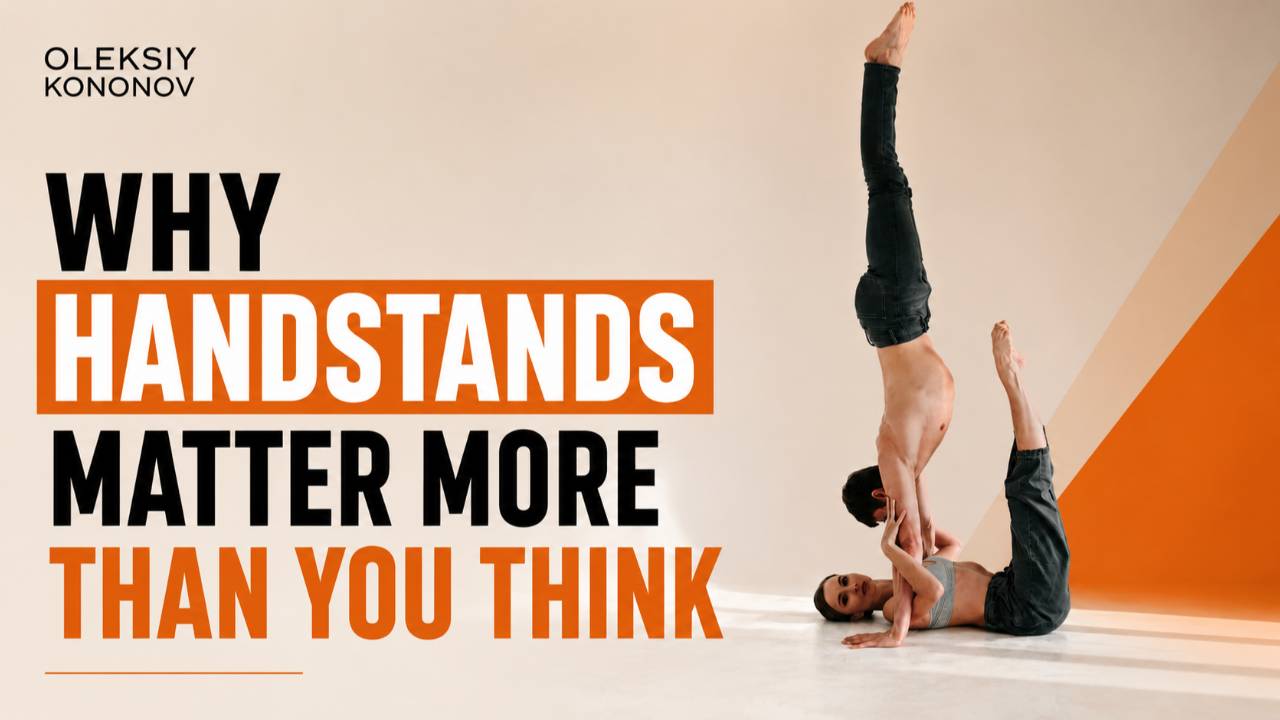
What 35 Years of Gymnastics Taught Me About Fear, Confidence, and Human Potential
Every week I receive messages from people who want to learn a handstand.
Some are 20 years old. Some are 60. Some are athletes. Some haven't exercised in years.
And almost all of them ask the same question: "Why do I want this so badly?"
It's an interesting question.
Because standing upside down is not essential for survival. You don't need it to drive a car, work on a computer, or pay your bills.
Yet for some reason, humans have been fascinated by handstands for centuries.
After more than 35 years in gymnastics, competing, performing with Cirque du Soleil, and coaching thousands of people, I think I finally understand why.
And the answer has very little to do with fitness.
The Day I Realized Handstands Are Not About Handstands
When I was a child, I didn't think about philosophy. I simply loved moving.
Nobody had to motivate me. Nobody had to explain the benefits. It was simply fun.
Years later, while coaching adults, I noticed something interesting.
Many adults had lost that feeling. They approached movement like a task — like work, like another item on the to-do list.
But the moment they started learning handstands, something changed.
Suddenly they became curious again. Playful again. Excited again. The same way children are.
That's when I realized: handstands reconnect us with a part of ourselves that many adults have forgotten — the part that loves challenges, exploration, and learning simply because learning feels good.
Why Handstands Are So Attractive
1. Handstands Look Impossible
Humans are attracted to challenges. Especially challenges that appear impossible at first glance.
When someone sees a handstand, their brain immediately says: "That's hard."
And something inside us becomes curious: what would it feel like if I could do that?
The handstand becomes more than a skill. It becomes a test.
2. Handstands Are Accessible
Think about climbing Everest — amazing challenge, but you need equipment, money, travel, time, risk.
For a handstand? You need a floor. That's it.
You can start today. In your living room. For five minutes or fifty minutes.
The barrier to entry is almost zero. And that makes it one of the most accessible personal challenges available.
3. Balance Feels Good
Have you ever balanced on a surfboard, a bicycle, or a skateboard?
There is a unique feeling when balance happens. For a brief moment everything aligns — the body, the mind, the movement, the environment.
Maybe that's why balancing upside down feels so satisfying. For a moment, chaos becomes order.
The Real Challenge Is Not Physical
After coaching thousands of people, I don't think the biggest obstacle in learning a handstand is strength.
It's fear.
Most adults are strong enough to begin. Most are mobile enough. Most are coordinated enough.
But many adults are afraid — of falling, of failure, of looking silly, of getting hurt.
The handstand simply exposes fears that already exist.
That's why I often say: a handstand is not a shoulder exercise. It's a conversation with your brain.
What Cirque du Soleil Taught Me About Fear
When I worked with Cirque du Soleil, people often assumed performers weren't afraid.
That's not true. The difference is not the absence of fear. The difference is the relationship with fear.
The best performers still feel fear. They simply learn how to move forward despite it.
The same applies to handstands. Confidence does not come first. Action comes first. Confidence follows.
The Coin System
When someone joins one of my handstand programs, I don't immediately ask them to balance freely.
Instead, I give them progression after progression. Small challenge after small challenge.
Each exercise is achievable. Each exercise creates a small victory. Each victory sends a message to the brain: "I can do this."
I imagine every successful exercise gives you a coin. One coin. Then another. Then another.
Eventually, your brain accumulates hundreds of pieces of evidence. Not motivation. Not positive thinking. Evidence.
And evidence is powerful. Because confidence built on evidence is real confidence.
This is exactly how the 21-Day Handstand Challenge is built — every day is one more coin in your confidence account, stacking toward a freestanding hold.
Learn How to Fall
One of the most valuable lessons I learned in gymnastics happened very early: I learned how to fall.
Most people think gymnasts are good because they know how to land. In reality, gymnasts become good because they know how to fall.
Many adults fear handstands because they have never learned how to safely exit one. The unknown feels dangerous. The known feels manageable.
That's why learning how to fall safely is often the first step toward learning how to fly.
The Hidden Benefit Nobody Talks About
People usually start handstands for physical reasons — stronger shoulders, better posture, more coordination.
All those benefits are real.
But after decades in gymnastics, I believe the greatest benefit is psychological.
The handstand teaches something much bigger: that progress is possible. That patience matters. That fear can be reduced through preparation. That extraordinary things are built through ordinary daily practice.
The Goal Is Bigger Than a Handstand
At KONONOV Club, I don't see handstands as the destination. I see them as a vehicle.
A vehicle to build confidence. To improve movement. To reconnect with your body. To remind yourself that growth is still available at any age.
I've seen parents achieve their first handstand at 50. I've seen office workers discover athletic ability they thought they had lost forever.
And that's why I still love teaching handstands after all these years.
Because every successful handstand tells the same story: you were capable of more than you thought.
Final Thought
You don't need to learn a handstand.
But if there is a part of you that has always wanted to try, I encourage you to listen to it.
Maybe you're not chasing a handstand. Maybe you're chasing proof — proof that you can still learn, still adapt, still grow, still surprise yourself.
And from my experience, that's a challenge worth pursuing.
I believe in you. Just do it 💪 — Oleksii Kononov
FAQ
Why do adults find it harder to learn physical skills than children?
Children approach movement with curiosity and no fear of failure. Adults bring expectations, fear of injury or embarrassment, and decades of habits that make unfamiliar positions feel threatening. The nervous system is still fully capable of learning at any adult age; the bigger obstacle is usually psychological, not physiological.
What is the "coin system" and how does it build confidence?
The coin system is a mental model where every successful exercise — no matter how small — deposits evidence into your brain's "I can do this" account. Confidence isn't built through motivation; it's built through accumulated evidence of competence.
Why is learning to fall important before learning a handstand?
Because much of the fear in handstands comes from the unknown consequences of losing balance. Once you've experienced controlled exits, the brain recategorizes the situation as manageable. Known risk is much less paralyzing than unknown risk.
What is the biggest long-term benefit of learning a handstand?
The most significant benefit is psychological: the direct experience of achieving something you once believed impossible. This creates a transferable belief that growth is still available — not just in physical skills, but in other areas of life.
Keep Reading
- How to Do a Handstand? — the complete step-by-step guide from foundation to first hold
- Handstand Preparation: Strengthen Your Body, Shoulders, and Wrists — build the base before going upside down
- The Power of Handstands: From Fear to Confidence — the deeper story of what handstands do to your mind
- The Real Secret Behind the 21-Day Handstand Challenge — the structured system behind real progress