How to measure handstand progress without a perfect hold
Jun 30, 2026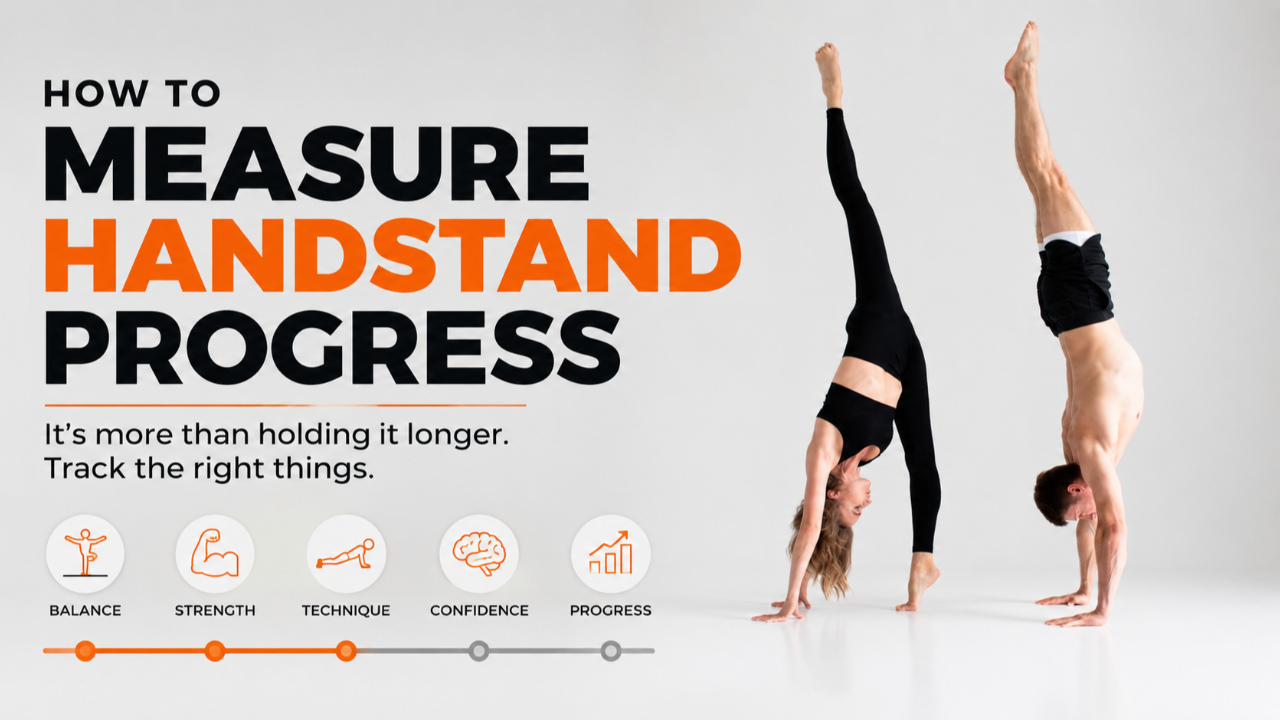
Most people think handstand progress means one thing:
Can I hold it longer?
But this is not the best measurement.
Real handstand progress starts before the full handstand. You measure it by better mobility, better stability, cleaner technique, less fear upside down, and by passing small preparation exercises step by step.
How do I know if my handstand is improving?
You are improving when your body becomes easier to control upside down.
Not only when you hold the handstand longer.
In gymnastics, one hard skill can be split into many small steps. A good coach can take one complex movement and break it into preparation exercises.
This is how I build handstand training.
One handstand becomes hundreds of smaller exercises.
Each exercise is a milestone.
Each exercise shows your level more clearly than just asking, can I hold a handstand?
For example, the plank position can be the start of your handstand journey.
Then we can modify the plank many times.
Each modification gives you a small challenge.
Each modification gives you a small win.
Each modification builds strength, confidence, and resilience.
This is real progress.
What should beginners practice before a full handstand?
Before a full handstand, beginners should prepare the body first.
The first level is mobility and stability of the wrists and shoulders.
You need to check how your joints work.
Can your wrists and shoulders move enough?
Do you have normal amplitude there?
If not, you need to improve this first.
After that, you need stability.
In a handstand, the body should feel like one strong piece. Like a monolithic piece.
When the body is connected, it is much easier to control it in a position that feels unfamiliar.
This also helps reduce unnecessary stress and small injuries.
The main base is:
- wrists
- shoulders
- core
- back
- body stability
After this, you can learn more handstand-specific technique.
How to move body weight into the hands.
How to use shoulders like leverage.
How to feel where your hips and legs are.
How to bring the hips above the palms.
How to keep the hips above the palms longer.
This is the real process.
Why does learning a handstand take time?
A handstand takes time because it is a highly coordinated skill.
Any new skill needs time.
Any gymnastics exercise needs time because it asks many parts of the body to work together.
You can have fun and try a wall handstand on day one. Like a kid.
But if you want to balance without the wall, it becomes much harder.
If you want a cleaner line, it takes more time.
If you want a better entry into handstand, it takes even more time.
For me, learning handstand is like learning a second language.
It is not a short project.
It is more like a lifelong project.
Gymnastics is about movement.
And movement can improve all your life.
My goal is simple:
Improve how I move.
Improve how I speak.
Improve how I think.
Handstand is one small area where you can practice this for many years.
Why is good technique better than more practice?
More practice with bad technique can make your problem stronger.
This is the scary part in gymnastics.
If you repeat a movement with wrong technique, your body adapts to the wrong technique.
Then this technique can stop you.
It can block the next level.
It can also increase injury risk.
And the hardest part is this:
It is very difficult to relearn.
Sometimes you need to destroy the old technique completely and build it again.
This can take years.
So do not rush in the beginning.
Learn clear technique from the start. This is why good technique beats more strength every time.
Gymnastics has a long history. Many people already tested many ways to move. We do not need to create a new bicycle.
We can take the basic knowledge that already exists.
Handstand position.
Headstand position.
Basic body line.
Shoulder position.
Wrist position.
It can feel a little boring in the beginning.
But later it gives you more freedom.
Good technique saves energy.
Good technique saves your joints.
Good technique gives you a path to improve for many years.
Wrong technique usually stops you at some point.
How often should adults practice handstands?
For adults, the first challenge is not technique.
The first challenge is lifestyle.
You need to create a habit of practice.
I understand this much better now because I am 40.
When I was a kid, I could lie down and think:
I am bored. What should I do?
Now life is different.
I have more tasks and projects than I can handle.
So if I want to add handstand practice, I need to remove something else.
Maybe less scrolling.
Maybe less random time on the phone.
Maybe 20 minutes from something that does not help me.
If you do not already have a daily practice habit, and you say, I want to learn handstand, it is a good idea.
But first you need space in your day.
At minimum, find 20 to 30 minutes.
This is often harder than mobility.
Harder than stability.
Harder than technique.
Changing lifestyle is harder than changing body shape.
But without this habit, the best program will not work.
It is like English.
Many people want to learn English and search for the perfect method.
But if they do not sit down every day and learn, the method does not matter.
It is the same with business.
You can search for tools and strategy.
But if you cannot find 30 minutes or one hour a day to work on your business, it will not work.
Handstand is the same.
First, create the space.
Then improve the practice.
What can you do today to measure handstand progress?
Start with small tests.
Do not only test the final handstand.
Try this:
- Check your wrist comfort in a plank position.
- Check if your shoulders can open overhead without forcing.
- Hold a strong plank and feel if your body is connected.
- Practice shifting body weight into your hands.
- Try a simple wall drill and notice if you feel more control.
- Record one video from the side.
- Compare the same exercise every week, not every day.
- Move to the next preparation exercise only when the current one feels stable.
This gives you clear feedback.
Not emotional feedback.
Not, I feel bad today.
Clear feedback.
Can you do exercise number 10?
Can you do exercise number 20?
Can you control exercise number 50?
This is how you see the real level.
If you want a structured path that takes you through these exact milestones step by step, that is what my 21-day Handstand Challenge is built around.
FAQ
How long does it take to learn a handstand?
Learning a handstand can take months or years because it is a coordinated gymnastics skill. You need mobility, stability, strength, body awareness, and clean technique. A wall handstand can happen fast, but balance without the wall takes more time.
What is the best way to measure handstand progress?
The best way to measure handstand progress is to track small preparation exercises. Better wrist comfort, stronger shoulders, cleaner plank control, better weight shift, and more confidence upside down all show progress before the full handstand hold.
Should I practice handstands every day?
Adults should first build a realistic practice habit. Even 20 minutes a day can help if the practice is focused and the technique is clear. Bad daily practice is not better than smart practice.
Why am I not getting better at handstands?
You may not be improving because you are only testing the full handstand instead of building the pieces. You may need more wrist and shoulder mobility, more stability, better body line, or cleaner technique before balance becomes possible.
Final thought
Do not wait for the perfect handstand to feel progress.
Every small step counts.
Every clear exercise you improve is a win.
Build the body.
Build the habit.
Build the technique.
I believe in you.
Oleksiy Kononov