Why technique beats strength in handstands
Jun 18, 2026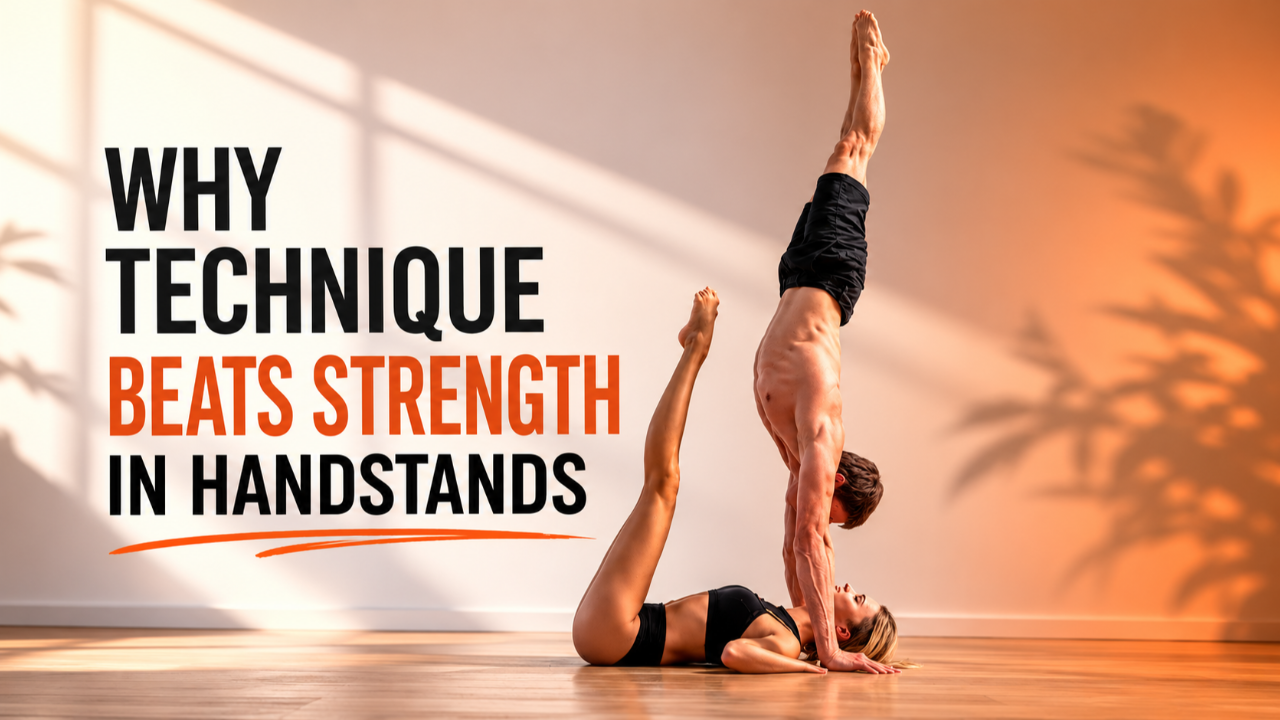
You don't need to become stronger before you learn a handstand.
You need to move better.
Yes, strength matters. But if you ask me what helps most adults finally hold their first handstand, my answer is almost never bigger muscles. It is better technique.
After more than 35 years in gymnastics, performing in Cirque du Soleil, and coaching thousands of adults, I have seen the same pattern again and again. Very strong people struggle to balance. Smaller people with good body awareness often learn much faster.
The goal is not to fight gravity harder. The goal is to work with it.
Why Do People Think Handstands Are All About Strength?
I understand why people believe it.
A handstand looks difficult. You see someone upside down, supporting their entire body on their hands. The first thought is usually: their arms must be incredibly strong.
That is what we notice first. It is the visible part of the iceberg.
But if you spend time inside gymnastics, you quickly realize something different: a handstand is never just about strength.
It is a combination of physical abilities working together — strength, mobility, coordination, balance, body awareness, and technique.
Take away one of those pieces, and everything becomes harder.
What Does Technique Actually Do?
Technique is simply the most efficient way to move.
Good technique allows you to produce better results while using less energy.
When your movement becomes more efficient, your body works less and achieves more. You stop fighting yourself. Instead of forcing a movement, you begin to cooperate with it.
I often explain it this way: imagine two people walking up the same hill. One chooses the easiest path. The other keeps climbing over rocks.
Both reach the top. One arrives fresh. The other is exhausted.
Technique is choosing the easier path. The destination is the same — the effort is completely different.
Why Strong People Still Struggle With Handstands
One of the biggest surprises for adults is discovering that strength alone does not create balance.
I have coached people who could lift impressive weights in the gym. They expected the handstand to be easy. Sometimes they became frustrated because it wasn't.
Then I have coached people with much smaller bodies and much less strength who learned faster.
Why? Because balancing upside down is a skill. Skills have to be learned.
You cannot bench press your way into better balance. You have to teach your nervous system how to organize your body in space. That takes practice — not just effort.
A big part of that organization starts at the center of the body. Read more: How to Use Core for Handstand Balance.
The Lesson I Learned From Starting Padel
Recently I started playing padel.
Like every beginner, I had almost no technique. But I already had years of strength, mobility, and athletic experience behind me.
Those physical abilities helped me enjoy the game immediately. But something became obvious very quickly: I was wasting energy.
Every point felt harder than it should. Not because I lacked fitness. Because I lacked technique.
The same thing happens with handstands. If you want longer holds, cleaner lines, better control, and less effort — technique becomes your biggest opportunity.
Why Alignment Makes Everything Easier
I often tell my students something very simple: bones do not get tired. Muscles do.
Imagine your body as a tower. If every part is stacked on top of the next, the structure supports itself much more efficiently.
Now imagine that same tower with bends everywhere — bent elbows, rounded back, closed shoulders, bent hips.
Every bend creates another place where your muscles have to work harder. Eventually they get tired.
Not because you are weak — because they are doing work that proper alignment could reduce.
Good alignment reduces unnecessary effort. That is a huge difference.
Five Things You Can Improve Today
- Film one handstand attempt and look at your body line instead of only counting seconds.
- Spend a few minutes improving shoulder and wrist mobility before balancing.
- Focus on creating one long straight line from your hands to your toes.
- Practice shorter attempts with better quality instead of longer attempts with poor position.
- Ask yourself after every session: did I become more efficient today, or did I only become more tired?
Small improvements in technique often produce bigger results than another set of push-ups.
If you want to train these technique principles inside a structured daily system, the 21-Day Handstand Challenge is built exactly for this — guiding you from foundation to a real freestanding hold, one technique principle at a time.
Final Thought
Strength helps you enter a handstand. Technique helps you stay there.
If you improve both, your progress becomes much faster.
But if you can only improve one today, choose technique.
Your muscles will always have limits. Better movement gives you something much more valuable: freedom.
I believe in you. — Oleksiy Kononov
FAQ
Can you learn a handstand without being very strong?
Yes. You need enough strength to support your body, but most beginners are limited more by technique, balance, mobility, and body awareness than by raw strength. Improving those areas often leads to faster progress than simply becoming stronger.
Why do strong athletes struggle with handstands?
Strength does not automatically create balance. A handstand is a coordination skill that requires your nervous system to organize your body in an efficient position. Even very strong athletes often need to learn this skill from the beginning.
Why is body alignment so important in a handstand?
Good alignment allows your skeleton to support your body more efficiently, reducing unnecessary work for your muscles. The better your body is stacked in a straight line, the less energy you waste trying to stop yourself from falling.
Should beginners focus on strength or technique first?
Work on both, but prioritize technique during every practice. Better alignment, mobility, and body awareness usually improve your handstand faster than adding more strength exercises alone.
Keep Reading
- How to Use Core for Handstand Balance — why the center of the body is the real foundation of technique
- 5 Essential Handstand Technique Tips — practical details to apply in your next session
- Balance & Stability: The Foundation of Movement — understand what balance actually is before trying to master it
- Handstand Preparation: Strengthen Your Body, Shoulders, and Wrists — the physical prep that makes technique possible
- Why Handstands Matter More Than You Think — the bigger reason behind the skill