How to Use Core for Handstand Balance
Jun 23, 2026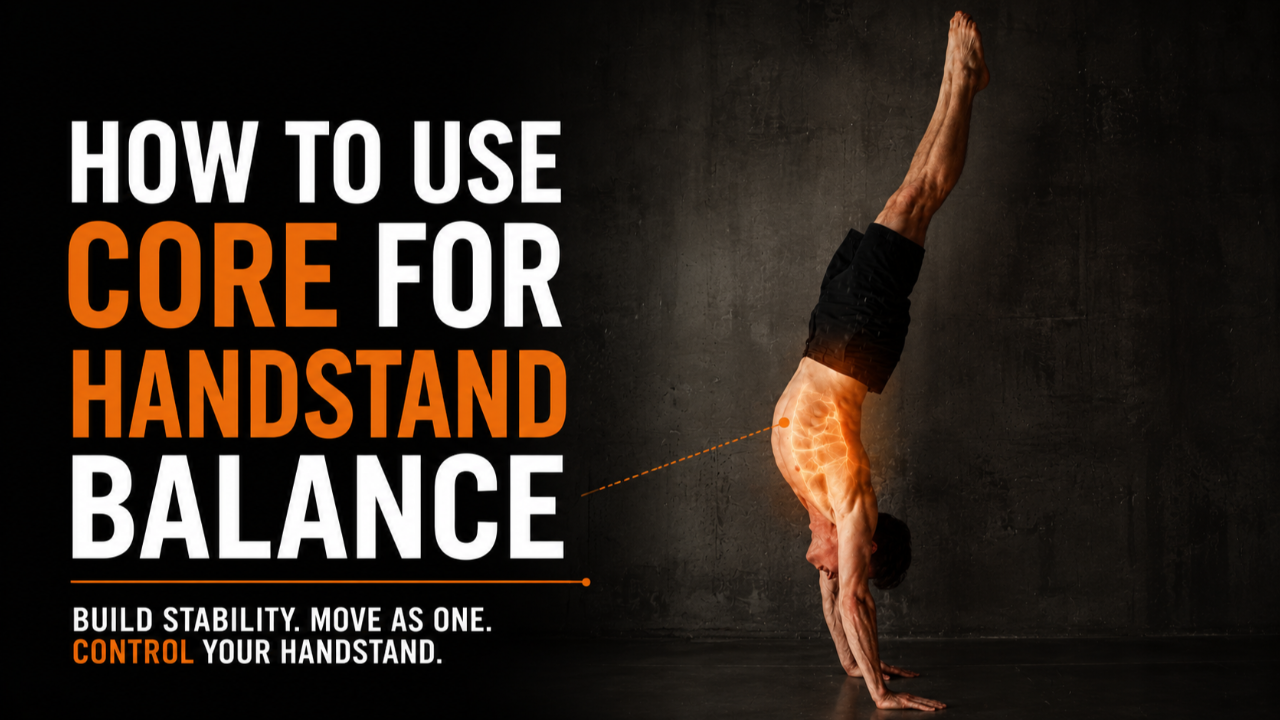
A handstand becomes easier when your body moves like one piece.
Not soft. Not shaking. Not broken into parts.
Your core helps connect your hands, shoulders, hips, and legs. When your center is stable, you can balance with less energy and more control.
Why Is Core Important for Handstands?
Your core is not just abs.
It is the center of your body. It includes the muscles around your abdomen, lower back, and hips.
In a handstand, your hands are on the floor. Your legs are in the air. But the main thing you are really controlling is your center of body — your center of gravity.
This is why I do not like to call the core only a bridge. For me, it is more than a bridge. It is the main part. Your arms and legs are connected to it.
In gymnastics, almost every movement starts from the center of the body.
When you take your head off the pillow in the morning, your core is already working. When you surf, your core works. When you make a strong kick in boxing or kickboxing, your core works. When you run, jump, walk, or land, your core works.
So when you go upside down, it becomes even more important.
Because now you are trying to control your whole body through your palms. That is not normal for most people. Normal is lying on the couch. Handstand is different.
Handstand starts falling the moment you enter it. Your job is not to freeze forever. Your job is to control the fall.
And your core gives you the body structure to do this.
How Does a Weak Core Affect Handstand Balance?
A weak core makes your handstand harder to control.
Your body starts shaking. Your hips move too much. Your legs disconnect from your shoulders. You spend more energy. You lose balance faster.
If your core is weak, it can be hard even to hold the handstand shape. It can also be harder to enter the position, move from the wall, or control small changes in balance.
But this is not only about handstands. A weak core can increase the risk of non-contact injuries when you run, jump, walk, or train.
For handstands, the risk becomes bigger because the movement is new for many people. Your wrists, shoulders, and neck are not used to this position. Your brain is not used to being upside down. Your body does not yet understand how to organize itself.
This is why core training should be part of almost every training program. Not because everyone needs six-pack abs. Because everyone needs control.
What Does a Stable Core Feel Like in a Handstand?
A stable core feels like your body is one piece. Like a monolith.
I often explain it this way. It is much easier to control a metal bar than a balloon filled with water. If your body is like a metal bar, one small correction from your palms can move the whole body. If your body is like a water balloon, everything moves late.
Your shoulders go one way. Your ribs go another way. Your hips collapse. Your legs bend. And your hands must work too much.
Your body should be straight, tight, and connected. Not tense like panic. Stable like one piece.
In handstand, a disconnected body is very expensive. You waste energy. You get tired faster. You feel unstable.
How Do I Test Core Stability for Handstand?
Here is one simple test I use when I coach people.
Lie on your back. Round your lower back a little. Engage your core. Keep your body connected. Now someone touches your shoulders and gently moves you. Your whole body should move as one piece. Not only your shoulders. Not your ribs first and legs later. One piece.
That is the first level.
Second level: give your arms to the person. They gently push your arms. Your body should still move as one piece.
Third level: they move your legs. Again, your body should move as one piece.
For many people, this is very hard. They can do many exercises. They can sweat. They can plank. But they cannot connect the body.
This is why I always start with stability. Before strength. Before power. Before tricks.
If you cannot stabilize your center on the floor, your handstand will be much harder upside down.
Is Core Training the Same as Strength Training?
Not exactly. Core training has levels.
The first level is stability. You learn how to feel your center. You learn how to engage your core. You learn how to keep the body connected. This is basic. But it is not easy. Many people cannot stabilize the core because they do not feel their body enough. So coordination is part of core stability.
The second level is strength and strength endurance. This is when you can lift your legs, lift your upper body, hold longer positions, and repeat movements.
The higher level is power. This is when you throw, hit, kick, or create fast force through the body.
All of this is core training. Just different levels.
For handstand beginners, the most important level is stability. You need to unlock this first.
If you want a structured daily program to build exactly this foundation, the Core Challenge is where to start — step by step, from basic stability to real strength endurance.
Can Too Much Tension Be Bad in a Handstand?
For beginners, good full-body tension is usually not the problem. Lack of control is the problem. Lack of mobility can be a problem. Poor alignment can be a problem.
But if your body is straight, your shoulders are open, and your whole body is engaged, tension helps you.
At a higher level, it changes. When you move into advanced handstand work, you need more freedom. You need to understand how to keep your center stable while your shoulders still move.
This is important because shoulders help you save the handstand. Your hips should be above your palms. There is a small balance corridor. It starts around your fingertips and ends around your wrist.
If your hips move outside this corridor, your palms alone may not save you. Then you need your shoulders. Your shoulders give you bigger leverage.
If you start to fall forward, your shoulders can move and help bring the center back. If you start to fall back, your shoulders can also help.
This is higher-level control. But for beginners, start simple. Make the body one piece first. Then learn how to move inside that one piece.
What Can You Do Today to Improve Core for Handstand?
Try this today.
- Lie on your back and gently round your lower back
- Engage your core like you want your body to become one piece
- Ask someone to gently move your shoulders
- Keep your whole body connected
- Repeat the same with arms and legs
- Then practice a wall handstand with the same feeling
- Think less about abs and more about connection
Do not chase hard exercises first. First, learn to control your center. Then strength will be more useful.
Not sure where your body actually stands? The General Body Checkup is a quick assessment that shows exactly which areas need work — core, hips, shoulders, and more — before you dive into any program.
FAQ
Why do I shake in a handstand?
You may shake because your body is not yet connected as one piece. Your hands, shoulders, core, hips, and legs are all trying to work separately, so you spend more energy and lose control faster.
Do I need strong abs for a handstand?
You need more than strong abs. You need core stability, body awareness, and the ability to keep your center connected to your shoulders and legs while upside down.
Should beginners train core before handstands?
Beginners should train core stability together with handstand practice. If you learn how to stabilize your body on the floor first, it becomes easier to control your shape upside down.
What is the best core exercise for handstand balance?
The best starting exercise is not the hardest one. Start with a simple body connection test on your back, where your whole body must move as one piece when your shoulders, arms, or legs are gently moved.
Final Thought
Handstand is not only about strong shoulders.
It is about control. Your core is the center of this game.
When your center becomes stable, your handstand becomes calmer. Less fight. More control. More confidence.
I believe in you. — Oleksiy Kononov
Keep Reading
- How to Do a Handstand? — the complete guide from foundation to first hold
- Why Technique Beats Strength in Handstands — why alignment and control matter more than raw strength
- 5 Essential Handstand Technique Tips — the practical details that make a difference
- Balance & Stability: The Foundation of Movement — what balance really is and how to train it
- The Real Secret Behind the 21-Day Handstand Challenge — the structured system behind real handstand progress